Please visit my other sites when you are free: http://rolex.2itb.com http://vintage-watch.blogspot.com/
Friday, September 20, 2013
Ls3/5a 的魔力
Pure Malt speakers
Thursday, September 19, 2013
Ls3/5a is meant to be used with its grille
There are many modern myths around Ls3/5a:
1. Speakers placement is critical
2. Ls3/5a needs to remove its grille when listening...
This article suggest that The LS3/5a is meant to be used with its grille in place...instead of removing...
http://www.enjoythemusic.com/hificritic/vol3_no3/rogers_ls35.htm
The BBC-licensed LS3/5A help make Rogers into a global brand. Its current Far East owners have worked with the UK designers an manufacturers to create this BBC-licensed 11 Ohm 'revival'.
We won't labour the LS3/5a story, which began in the BBC in early 1970s, as this was covered in depth in Vol1 No3 (May-June 2007). The fit and finish of this official £1499/pair Rogers revival was excellent. It certainly looks the part with its fine matched rosewood veneer, though the repro Tygan grille material might be a little softer and more open than the original. As expected, these speakers use a 5-inch (138mm) polymer cone bass/mid drive unit partnered by a nominally 19mm dome tweeter, mounted in a sealed-box enclosure. Build detail includes thick felt absorption around the tweeter, to ameliorate reflection effects from the integral grille frame. (The LS3/5a is meant to be used with its grille in place.)
This new example has a glued on back, as were most LS3/5as. The bass/mid driver has a 110mm pressed steel chassis with a flared, talc-filled polypropylene cone, powered by a double-wound voice-coil (the windings series connected), and a large ferrite magnet. A fine 19mm tweeter with recessed soft dome and sophisticated rear loading is fitted, while that unnecessary perforated metal cover completes the original look. Built of birch plywood according to the original recipe, the panels are well damped by traditional bitumen loaded pads, and the interior is lined with thick, absorbent polyurethane foam. This model is bi-wired (unlike the original) with average quality gold plate brass binding posts and brass link pins (preferably replaced by copper wire on installation). The crossover is built on the usual epoxy glass reinforced PCB, securely bolted to the panel area around the tweeter. It uses normal film capacitors, ferrite core inductors, and an array of resistors forming a calibrated attenuator to achieve the essential close tolerance matching of mid and treble levels. (The original 15ohm model used mu-metal cored transformer inductors and ratio matching of driver sensitivity levels.)
Sound Quality
With references assembled, and memory not too dimmed from the pleasant experience of that other, Derek Hughes guided 11 Ohm LS3/5a for Stirling Broadcast (Vol1 No3), I set to. Location as ever, was free space with little toe-in, and copper links fitted to the terminals.From the very start that genuine LS3/5a magic was there, though inevitably at modest loudness levels. Shut your eyes and coloration is really low, and the soundstage is spacious, deep and focused. The natural timbre and the elegant, surprisingly deep image perspective reminds one of much larger and more costly designs. If a listener doesn't demand higher volume levels or need cracking dynamics, it might not be necessary to go further than this in the quest for genuine high fidelity.
In my opinion this is the best of the modern LS3/5a clones I've heard to date. It has quite good coloration in the low midrange -- a weakness of many -- though it is a little 'boxier' than the best 15 Ohm examples. It is also a little 'sweet', not quite as crisp and open as is possible, though one would not want it as bright as some later original Rogers 15 Ohm examples. This new contender is self-effacing, clean, even, smooth and well balanced, with a particularly seamless transition from midrange to treble, albeit a tad dynamically reticent in the piano's middle register. Spacious, transparent and detailed, if a touch 'darker' (and therefore not quite a dynamic, expressive, transparent or 'powerful', this new version of that old trouper just sounds bigger than the original, with a touch more realism.
This new Rogers certainly has a good percentage of the better drive and timing of the earliest models. We should remember that middle period 15 Ohm models often sounded hard and forward in the midband, only just meeting the BBC spec. This new version actually bests a huge number of the less good 15 Ohm models, never mind the more boring 11ohm examples and most of the 3/5 clones (which were never proper 3/5as anyway). In reality this Rogers is quite close to the standard, comparing well with the equally well mannered and similarly neutral Stirling Broadcast version. I think that it may be just a little livelier musically than the Stirling Broadcast, but reckon you would have to do an A/B to find out.
Measurement
The spec says 83dB/W/m sensitivity, some 1.5dB higher than the original 15ohm model, and truthful. Frequency responses were very tidy, and with superb pair matching. The on-axis frequency response gives 70Hz to 29kHz +/-3dB, with -6dB points at 60Hz and 30kHz. Partnering stands should not be too high because the response dips sharply by 10dB at 10 degrees below the axis in the crossover zone, around 3.3kHz, while remaining perfect at 10 degrees above. The speaker should therefore be sited at or a little below seated ear level. The off-axis lateral results were good too, but that noted dip was beginning to show itself in the 45 and 60 degree off-axis results. The small tweeter keeps the output going nicely up to 11kHz off-axis, so it should stay open and clear. The bass is understandably limited with some characteristic 'plumpness' 80 to 150Hz, though this is part of the 'voice' of this little box. The in-room averaged response (not shown) is very good: it's typical for the size, with good overall power integration and with in-room bass down to about 50Hz.
The impedance graph shows an average value of about 7 Ohms. It's easy to drive, with a minimum of 5ohms and moderate variation. The box bass resonance is seen at 91Hz. The waterfall response is quite tidy, well integrated in the early response, with only moderate decay clutter thereafter. Enclosure coloration is low thanks to the good construction and small acoustic footprint.
Conclusions
This LS3/5a contender can be recommended. It's beautifully made with great care and fine finish, and while I still await the equal of my ancient Robin Marshall made BBC originals perhaps it simply cannot be done, as some of the materials used to make that speaker are no longer available.
Contact
RoyalHiFi
Tel: +44 01628 820134
e-mail royalhifi@aol.com
Price: £1499/pair---------------another nice article------------BBC LS3/5a loudspeaker
By J. Gordon Holt Various • Posted: Mar 17, 1977These diminutive little sleepers have been available in the US for quite some time but have attracted little attention because (1) they have never really been promoted and (2) they are just too small to look as if they could be worth $430 a pair.
Originally designed by the BBC for monitoring of on-location broadcast and recording pickups (footnote 1), they hide most of their cost—a complex equalizer and phase-corrected crossover network—inside a cabinet only slightly larger than a shoe box. They were intended for "close-in" listening in a small control room rather than to fill a large room, and they will definitely notput the kind of levels beloved of rock nuts without woofer-bottoming or ultimately permanent damage.
Despite what must be a rather large amount of built-in bass boost (to compensate for the small size of the woofer), they are fairly efficient: We would estimate around 1¾%, which is comparable to an average acoustic-suspension system. Maximum safe output level is around 95dB SPL (sound pressure level) at a listening distance of up to 15', which is about as loud as a symphonic crescendo from 10' behind the conductor. This is with full-range program material; the limiting factor on power input is the "woofer" (because of its bass boost), so when the speakers are used with a subwoofer (crossing at 60 to 80Hz), they are capable of a clean 100 to 105dB, which is enough to give any masochist a most gratifying case of permanent ear damage.
Judging by their size, one's first thought is likely to be that these will work just dandy up on the wall, right below the ceiling and toward the room corners, where standing-wave resonances in the room will help augment the speakers' thin bass. But their size is very deceptive. These arenot thin-sounding. In fact, they produce an overall balance similar to that of a pair of large systems when they (the Rogers) are located on 30"-high stands, right out near the center of the floor. (This bass-balance design is consistent with the BBC's recent research findings which showed that the smoothest bass response is obtained when a speaker is as far as possible from room boundaries.)
It is because these speakers are so well-balanced when they are out in the room that they may well produce too much bass when placed against a wall, particularly when located near the junction between three room surfaces. In corners, they are (in most rooms) intolerably boomy because they are designed for out-of-corner placement, and because that location excites the maximum number and amplitude of standing-wave resonances (footnote 2) in the room.
The close proximity of room surfaces (or, worse yet, of a box or shelf under the speakers) also causes diffraction interference—the chopping of deep holes in the frequency response due to selective cancellation of certain frequencies. The smaller the speaker enclosure, the less audible are these diffraction effects and the smoother the system sounds. But nearby corners and surfaces can spoil the advantage of the small enclosure.
Another advantage of a small sound source is that it tends to radiate sound waves as expanding spheres rather than as a planar wave (as from large screens). Human ears react in a seemingly paradoxical manner to a spherical sound field: The reproduced sound seems, much bigger than its source, yet the angular localization of sounds across the "stage" between the speakers (ie, the imaging) is dramatically improved. In fact, the apparent audible size of these tiny speakers is almost laughable; we had the feeling that it just could not possibly be.
Adding to the illusion of a large speaker system, is the remarkable low-end performance, which is not really all that deep (subjectively flat to a bit below 57Hz in our rooms) but sounds deeper than it is because the response is actually pretty flat down to there (rather than drooping), and the bass detail is astonishing from 5" woofers. The speakers gave such a startling account of themselves at the low end that we were not acutely aware of the lack of deep bottom until deeper notes (as from bass drum or the bottom range of the string bass) that we knew were on the recording failed to come through.
High-end performance is quite remark able. The speakers have a very slightly rising response above about 5kHz (fig.1), but because there is no audible peak at the top, the rise does not cause any sizzling or spitting, but tends rather to exaggerate slightly the extreme high-end energy in the program, adding a bit more sibilance to voices, a bit more shimmer to cymbals, and a bit more overall airiness to the sound than is actually in the program material (footnote 3).
We were not able to determine how far out the high end goes, because our oscillator's upper limit is 20kHz, but the smoothness and the ability to reproduce hard transient information (triangles, castanets, etc.) suggested that 27kHz might not be a bad guess for the upper rolloff point. Overall, the monitors have an extraordinary feeling of depth and breadth to their sound. Inner details were excellently rendered, and there were no audible vowel-like colorations that we could detect. The only thing we could the Monitors on (other than the low-end range) was a subtle tendency to lighten or "stretch upwards" the vowel structure of some instrumental sounds. The effect could be likened to the difference between the lower range of an oboe and the upper range of an English horn, although the extent of the difference was less.
Qur comments about the sound of these speakers have thus far been based on its performance with what we feel (as of this writing) to be the best available power amplifier: the Audio Research D-150. (The new Audio Research equipment has just been announced, but will not have been auditioned by the time we return our Monitors.) We freely acknowledge the idiocy of driving a $430 pair of speakers with a $2700 power amplifier, but we can report that these Rogers/BBC speakers did just as well (if not slightly better in one one respect: a less "hot" high end) when driven by a Dual 76A. It is both a tribute to, and a liability of, these speakers that the lesser their driving equipment, the worse they sound. They reproduce the high-end roughness of solid-state amplifiers mercilessly, and most such amplifiers tend also to dry up their bass end a bit so that they lose some of their nice bottom fatness. (Placing them nearer to room boundaries then helps to compensate).
As for room placement: Except for the possible detrimental effects of standing waves, these are refreshingly uncritical of room placement. They are, as we said, best used on stands, and any carpenter can make up a pair. The speakers should be about 6' apart and 10-12' from the listening area, and each should be toed inwards, by about 5 degrees.
Optimally placed, and driven by suitably high-quality electronics and signal sources, these are a perfect way of getting sound that is comparable to that from Quad electrostatics, at far lower cost and with added bonuses of slightly smoother high end, better stereo imaging, a broader listening area, and considerably greater apparent (that is, audible) size. Their low-end output is, in most rooms, deeper and fuller than that of the Quads, but like the Quads, their major weaknesses are limited sound output and lack of extreme bottom. Above 60Hz, the Rogers BBC minimonitors outperform the vast majority of systems costing upwards of $500 per channel. And with the addition of subwoofering, via M&Ks or Janises, these could provide perfoorance comparable to that of some of the best systems com mercially available, regardless of cost.
The only real handicap that we can see to owning a pair of these is that your tineared friends won't be as impressed as they would be if your speakers took up the whole East Wall of your living room.
Footnote 3: Stereophile's subjective frequency response curves show how the transducer under test sounded to us, rather than how it measured. The vertical scale on each curve is the same, and is scaled so that a barely perceptible audible deviation from flat frequency response is reflected in a barely perceptible visual deviation of the response curve.
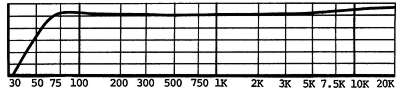
Fig.1 Rogers LS3/5a, "subjective" frequency response.
A Followup appeared in December 1977 (Vol.4 No.1):
Subsequent experience with these remarkable little speakers has strengthened our feeling that that they should not be used with solid-state power amplifiers. The speakers need a slight high-end softening, and are more likely to overload (the woofers bottom, making an alarmingly loudbang) from the average solid-state amp. An Audio Research Dual 51A is ideal (with a solid-state amplifier for the woofers if you choose to bi-amp), while an upgraded Dynaco Stereo 70 does very well. The Audio Research D76A is fine but has more power (and a higher price) than is necessary.
Output level is limited to around 85dB with a high-powered, wideband solidstate amp, 95dB with tubed electronics and no subwoofer. With a subwoofer and the Rogers rolled off below 70 or 100Hz, listening levels of over 100dB can be obtained without stress.
If you missed our full report on these in the last issue, a summation: Superbly balanced sound overall; very subtly nasal in some rooms; slightly rising (above 5kHz) but very smooth and extended high end; no deep bass but deficiency not noticeable on most program material; very good detail; extremely large apparent soundsource; very good stereo imaging; limited output level.—J. Gordon Holt
Source:
http://www.stereophile.com/content/bbc-ls35a-loudspeaker-1977-bbc-version-part-2
1977 review of the LS3/5a
BBC LS3/5a loudspeaker
Originally designed by the BBC for monitoring of on-location broadcast and recording pickups (footnote 1), they hide most of their cost—a complex equalizer and phase-corrected crossover network—inside a cabinet only slightly larger than a shoe box. They were intended for "close-in" listening in a small control room rather than to fill a large room, and they will definitely notput the kind of levels beloved of rock nuts without woofer-bottoming or ultimately permanent damage.
Despite what must be a rather large amount of built-in bass boost (to compensate for the small size of the woofer), they are fairly efficient: We would estimate around 1¾%, which is comparable to an average acoustic-suspension system. Maximum safe output level is around 95dB SPL (sound pressure level) at a listening distance of up to 15', which is about as loud as a symphonic crescendo from 10' behind the conductor. This is with full-range program material; the limiting factor on power input is the "woofer" (because of its bass boost), so when the speakers are used with a subwoofer (crossing at 60 to 80Hz), they are capable of a clean 100 to 105dB, which is enough to give any masochist a most gratifying case of permanent ear damage.
Judging by their size, one's first thought is likely to be that these will work just dandy up on the wall, right below the ceiling and toward the room corners, where standing-wave resonances in the room will help augment the speakers' thin bass. But their size is very deceptive. These arenot thin-sounding. In fact, they produce an overall balance similar to that of a pair of large systems when they (the Rogers) are located on 30"-high stands, right out near the center of the floor. (This bass-balance design is consistent with the BBC's recent research findings which showed that the smoothest bass response is obtained when a speaker is as far as possible from room boundaries.)
It is because these speakers are so well-balanced when they are out in the room that they may well produce too much bass when placed against a wall, particularly when located near the junction between three room surfaces. In corners, they are (in most rooms) intolerably boomy because they are designed for out-of-corner placement, and because that location excites the maximum number and amplitude of standing-wave resonances (footnote 2) in the room.
The close proximity of room surfaces (or, worse yet, of a box or shelf under the speakers) also causes diffraction interference—the chopping of deep holes in the frequency response due to selective cancellation of certain frequencies. The smaller the speaker enclosure, the less audible are these diffraction effects and the smoother the system sounds. But nearby corners and surfaces can spoil the advantage of the small enclosure.
Another advantage of a small sound source is that it tends to radiate sound waves as expanding spheres rather than as a planar wave (as from large screens). Human ears react in a seemingly paradoxical manner to a spherical sound field: The reproduced sound seems, much bigger than its source, yet the angular localization of sounds across the "stage" between the speakers (ie, the imaging) is dramatically improved. In fact, the apparent audible size of these tiny speakers is almost laughable; we had the feeling that it just could not possibly be.
Adding to the illusion of a large speaker system, is the remarkable low-end performance, which is not really all that deep (subjectively flat to a bit below 57Hz in our rooms) but sounds deeper than it is because the response is actually pretty flat down to there (rather than drooping), and the bass detail is astonishing from 5" woofers. The speakers gave such a startling account of themselves at the low end that we were not acutely aware of the lack of deep bottom until deeper notes (as from bass drum or the bottom range of the string bass) that we knew were on the recording failed to come through.
High-end performance is quite remark able. The speakers have a very slightly rising response above about 5kHz (fig.1), but because there is no audible peak at the top, the rise does not cause any sizzling or spitting, but tends rather to exaggerate slightly the extreme high-end energy in the program, adding a bit more sibilance to voices, a bit more shimmer to cymbals, and a bit more overall airiness to the sound than is actually in the program material (footnote 3).
Footnote 1: American visitors to England consistently report that the BBC transmits superb-quality sound and that unlike the US (where practically everything aired is canned), Britons are privileged to hear frequent live broadcasts of orchestra concerts. It is thus reasonable to assume that the BBC engineers know good sound when they hear it.
Footnote 2: A standing wave occurs when a sound wave travels to one room surface and back again in exact synchronism with the reproduced frequency, causing an energy buildup (a response peak) between the surfaces.
We were not able to determine how far out the high end goes, because our oscillator's upper limit is 20kHz, but the smoothness and the ability to reproduce hard transient information (triangles, castanets, etc.) suggested that 27kHz might not be a bad guess for the upper rolloff point. Overall, the monitors have an extraordinary feeling of depth and breadth to their sound. Inner details were excellently rendered, and there were no audible vowel-like colorations that we could detect. The only thing we could the Monitors on (other than the low-end range) was a subtle tendency to lighten or "stretch upwards" the vowel structure of some instrumental sounds. The effect could be likened to the difference between the lower range of an oboe and the upper range of an English horn, although the extent of the difference was less.
Qur comments about the sound of these speakers have thus far been based on its performance with what we feel (as of this writing) to be the best available power amplifier: the Audio Research D-150. (The new Audio Research equipment has just been announced, but will not have been auditioned by the time we return our Monitors.) We freely acknowledge the idiocy of driving a $430 pair of speakers with a $2700 power amplifier, but we can report that these Rogers/BBC speakers did just as well (if not slightly better in one one respect: a less "hot" high end) when driven by a Dual 76A. It is both a tribute to, and a liability of, these speakers that the lesser their driving equipment, the worse they sound. They reproduce the high-end roughness of solid-state amplifiers mercilessly, and most such amplifiers tend also to dry up their bass end a bit so that they lose some of their nice bottom fatness. (Placing them nearer to room boundaries then helps to compensate).
As for room placement: Except for the possible detrimental effects of standing waves, these are refreshingly uncritical of room placement. They are, as we said, best used on stands, and any carpenter can make up a pair. The speakers should be about 6' apart and 10-12' from the listening area, and each should be toed inwards, by about 5 degrees.
Optimally placed, and driven by suitably high-quality electronics and signal sources, these are a perfect way of getting sound that is comparable to that from Quad electrostatics, at far lower cost and with added bonuses of slightly smoother high end, better stereo imaging, a broader listening area, and considerably greater apparent (that is, audible) size. Their low-end output is, in most rooms, deeper and fuller than that of the Quads, but like the Quads, their major weaknesses are limited sound output and lack of extreme bottom. Above 60Hz, the Rogers BBC minimonitors outperform the vast majority of systems costing upwards of $500 per channel. And with the addition of subwoofering, via M&Ks or Janises, these could provide perfoorance comparable to that of some of the best systems com mercially available, regardless of cost.
The only real handicap that we can see to owning a pair of these is that your tineared friends won't be as impressed as they would be if your speakers took up the whole East Wall of your living room.
Footnote 3: Stereophile's subjective frequency response curves show how the transducer under test sounded to us, rather than how it measured. The vertical scale on each curve is the same, and is scaled so that a barely perceptible audible deviation from flat frequency response is reflected in a barely perceptible visual deviation of the response curve.

Fig.1 Rogers LS3/5a, "subjective" frequency response.
A Followup appeared in December 1977 (Vol.4 No.1):
Subsequent experience with these remarkable little speakers has strengthened our feeling that that they should not be used with solid-state power amplifiers. The speakers need a slight high-end softening, and are more likely to overload (the woofers bottom, making an alarmingly loudbang) from the average solid-state amp. An Audio Research Dual 51A is ideal (with a solid-state amplifier for the woofers if you choose to bi-amp), while an upgraded Dynaco Stereo 70 does very well. The Audio Research D76A is fine but has more power (and a higher price) than is necessary.
Output level is limited to around 85dB with a high-powered, wideband solidstate amp, 95dB with tubed electronics and no subwoofer. With a subwoofer and the Rogers rolled off below 70 or 100Hz, listening levels of over 100dB can be obtained without stress.
If you missed our full report on these in the last issue, a summation: Superbly balanced sound overall; very subtly nasal in some rooms; slightly rising (above 5kHz) but very smooth and extended high end; no deep bass but deficiency not noticeable on most program material; very good detail; extremely large apparent soundsource; very good stereo imaging; limited output level.—J. Gordon Holt
Review of Ls3/5a
The various versions of LS3/5As out there are cult favorites, and these speakers command anywhere from $1000 to over $3000 on eBay and Audiogon, depending on condition, presentation, and the ubiquitous “randomness factor.” I’ve heard that the Chartwell version is among the most rare and most likely to command really high prices in the audiophile used market. Given my experience with these speakers, I’d say that their status is well-deserved.
One final thing I noticed about these speakers is that they didn’t seem to care where the listener was in the room. They threw a nice image and sounded well-balanced even as we moved about my listening room. I’ve also read that they aren’t particularly placement-sensitive, though I didn't experiment with speaker placement.
Ways to enhance LS3/5a
Mass will absorb vibration. The owl filled sand will work well... Moreover, adding extra weight on top of your speaker will force your speaker to have firm contact with the ground, therefore grounding the vibration to the floor more effectively.
Wednesday, September 18, 2013
The Royal Ballet Gala Performance : Ernest Ansermet
PYOTR ILYICH TCHAIKOVSKY (1840-1893)
TNutcracker Suite, Op. 71a: excerpts
1.March
2.Dance of the Sugar Plum Fairy
3.Arabian Dance (Coffee)
4.Chinese Dance (Tea)
5.Dance of the Mirlitons
6.Waltz of the Flowers
GIOACHINO ROSSINI (1792-1868)
La Boutique Fantasque: excerpts
7.Tarantella
8.Andantino mosso
9.Can-Can
LEO DELIBES (1836-1891)
Coppelia: excerpts
10.Prelude - Mazurka
11.Introduction and Waltz
12.Czardas (Danse hongroise)
13.Valse de la poupee
ADOLPHE ADAM (1803-1856)
Giselle: excerpts
14.Introduction and Waltz
15.Pas de deux and Variation
CD 2
PYOTR ILYICH TCHAIKOVSKY
Swan Lake, Op. 20: excerpts
1.Scene (moderato)
2.Danse des petits cygnes (moderato)
3.Pas de deux
4.Valse
ROBERT SCHUMANN (1810-1856)
Carnaval, Op. 9: excerpts
orch. Glazunov, Rimsky-Korsakov
5.Pierrot
6.Reconnaissance
7.Pantalon et Colombine
8.Aveu
PYOTR ILYICH TCHAIKOVSKY
The Sleeping Beauty, Op. 66: excerpts
9.Introduction: Prologue - The Lilac Fairy
10.Rose Adagio
11.Valse
FREDERIC CHOPIN (1810-1849)
orch. Roy Douglas
12.Prelude
13.Mazurka
14. Valse
Friday, September 06, 2013
Restoration of Ls3/5a
Ls3/5a
Monday, September 02, 2013
Chartwell LS3/5a
Saturday, August 31, 2013
Speakers for Singapore
陳奕迅:好久不見
我來到 你的城市 走過你來時的路
想像著 沒我的日子 你是怎樣的孤獨
#拿著你 給的照片 熟悉的那一條街
只是沒了你的畫面 我們回不到那天
*你會不會忽然的出現 在街角的咖啡店
我會帶著笑臉 揮手寒喧 和你 坐著聊聊天
我多麼想和你見一面 看看你最近改變
不再去說從前 只是寒喧 對你說一句
只是說一句 好久不見
Friday, August 30, 2013
Fuller EL34 tubes
Tuesday, August 27, 2013
Skeeter Davis : here's the answer
Monday, August 26, 2013
Fuller hifi audio tube EL34
Sunday, August 18, 2013
Hifi
Saturday, August 17, 2013
Rogers LS3/5a black badge
我想起了二十多年前,香港雜誌上一句Rogers LS3/5a的廣告詞──「渺小見偉大」。
一路從好奇、追尋、迷惘、唾棄,到頓悟,其間花了我無以數計的金錢和十多年的歲月,一路上我與它分分合合,就像人與人間的緣份起滅,或許此時的相遇,是彼此最對的年歲,如果人的一生只能帶一對喇叭前往一座孤島,我會毫不猶豫舍下昂貴的guarneri而選3/5a。人生風雨已太多,恬靜的角落卻難求。


